





On "Mysteries of Eurasia: The Esoteric Sources of Alexander Dugin and the Yuzhinsky Circle"
Primary tabs
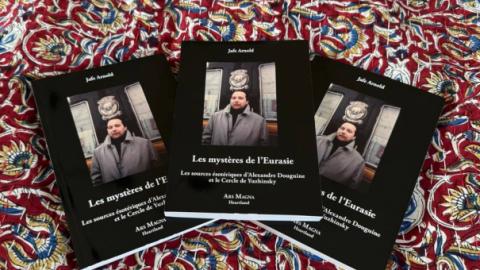
“Mysteries of Eurasia: The Esoteric Sources of Alexander Dugin and the Yuzhinsky Circle” was the thesis that completed my studies in Western Esotericism at the Center for the History of Hermetic Philosophy and Related Currents at the University of Amsterdam, where I obtained my Research Master’s degree in Theology and Religious Studies. The original thesis in English has been free to read and download on Academia.edu.
Despite the well-meaning wishes of a number of colleagues and several opportunities, I was always against publishing (and therefore editing) the thesis as a book, for reasons mentioned below. But in 2024, when Dr. Christian Bouchet of Ars Magna, the publisher of Alexander Dugin in French, insisted that the work as it is would still be of interest and value to French readers, I agreed on the condition that I could write a special, retrospective preface.
Les mystères de l’Eurasie. Les sources ésotériques d’Alexandre Douguine et le Cercle de Yuzhinsky was published as part of Ars Magna’s Heartland series in 2025. Here, belatedly, for the first time in English, is that preface.
Preface to the French Edition
It is rather unusual for a Master’s thesis to be published, completely unchanged, as a book. It is especially uncanny for me that my own Master’s thesis would be published in the language and country where one of the first universities was born and whose high academic tradition was an essential part of the Medieval European world, where the title and role of “magister” was central and was borne by great theologians and philosophers, which is far from the reality today. Therefore, when Dr. Christian Bouchet approached me with the proposal to publish my thesis, I was, although honored, naturally hesitant. Ultimately, nevertheless, as the book in your hands attests, I agreed — without requesting to make any changes to the text. This was motivated by a hermeneutic principle: the thoughtful life, the bios theoretikos, means that one is called to face life, to accept the challenges and opportunities it presents, even when we would otherwise prefer to postpone things for “editing”; in the beginning and in the end, it is the experience of the path of thinking, and the sharing of its milestones, that is often more valuable than the terminological result.
Thus, the book before you now is the French translation of my thesis, originally written in English and submitted in 2019 for the degree of Research Master in Religious Studies and Theology, specializing in Western Esotericism, at the Center for the History of Hermetic Philosophy and Related Currents (CHHP) at the University of Amsterdam. My studies there, like much of my intellectual and life path, were directly, organically connected to the subject of my thesis, namely, the thought of Prof. Alexander Dugin. Having discovered Dugin’s writings, especially Mysteries of Eurasia, at a young age, I went to the University of Amsterdam to immerse myself in the study of the esoteric “themes” and “language” in which Dugin’s works abound, and which, as my thesis argues, constituted the original “sources” of Dugin’s early thought as formed in the matrix of the Yuzhinsky Circle. Perhaps by coincidence, perhaps not, Dugin himself visited and spoke in Amsterdam on three occasions during my time there.1 Although Dugin expressed support for my thesis, our actual conversations back then were, somewhat ironically in light of what will be said below, entirely centered around his more recent works which are not treated in my thesis.2 Only later, at one of Prof. Dugin’s online seminars held during the 2020 Covid lockdowns, did I receive his positive feedback on the thesis itself. Of course, I recount such not with the intention of claiming any “approval,” but rather for the sake of disclosing that the author of Mysteries of Eurasia himself is aware of the contents of my little “Mysteries of Eurasia,” which was one of the first attempts in the West and in English (and now French) at interpreting his own and its Yuzhinsky origins.
But there was a “problem” with my thesis. As is well known, Dugin’s thought is bound up with a deep critique and radical opposition to the intellectual and political paradigm that reigns in the West. Accordingly, it is only natural that the intellectual establishment of the West, as partially represented by academia, dislikes him with a passion, to the point of often resorting to two of the foremost discursive maneuvers at disposal in the Western intellectual “canon”: (1) denouncing him as a “fascist” and (2) raising a wall of silence around him. As a young student passionately seeking to understand the matters at hand, and myself sharing no prejudices in favor of the reigning paradigm, nor having any academic position that could be threatened by retribution, I brazenly, publicly violated both of these edicts. Hence, I “couldn’t be trusted,” or, as one professor told me in private, I had prematurely committed “academic suicide.” Eventually, a department discussion was even held to determine whether I should be allowed to proceed with writing and submitting the proposed thesis. At one point of dismay, while waiting for the decision, it was Daria Dugina whose words encouraged me to be resilient, patient, and “eschatologically optimistic.” Ultimately, a green light was granted, but on the condition of what were called “clear restrictions”, which I shall now quote: “The thesis should be strictly historical, based on an analysis of the documented history of Dugin’s work and activities in that period and in that context; we ask you to refrain from general theoretical and/or political etic discussions of generic -isms such as ‘fascism’, ‘geopolitics’, ‘Eurasianism’, ‘esotericism’, etc.”
How can one delve into the works of an author accused, no matter how disingenuously, of being a “fascist” without addressing the question of “fascism,” including the author’s own deliberations on the matter? Refraining from broaching geopolitics, how can one treat the works of someone widely known as the “founding father of contemporary Russian geopolitics,” the author of the government-attended Foundations of Geopolitics, the thinker whose early works say that geopolitics has a definite relationship to one of his main topics at hand, namely, “sacred geography”? How can one treat the works of the first and foremost “neo-Eurasianist,” who rediscovered and redistributed Eurasianist thought not only in his own country, but across the world, without going into Eurasianism? And how could a student studying esotericism in the world’s only Master’s program on the subject, and dealing with an esoteric author who thematizes esotericism, be denied the possibility of putting forth “theoretical” and “etic” considerations? Of course, these are rhetorical questions which the thesis in question had to pass over in loud silence. Naturally, my thesis would probably have been quite different if it had been allowed to engage such questions, but I share this with readers not for the sake of bemoaning some past circumstances. Instead, I share such, firstly, to draw attention to the obviously inherent restrictions of a paradigm whose “scientific” institutions decide in advance what is to be a disputable “-ism” or disposable “theoretical question,” and who can be allowed to take up such. Surely, such an establishment was not and is not ready to understand and interpret the works of Alexander Dugin and the Yuzhinsky Circle. My thesis could thus also be read as a case study of working within, and between, such lines. At any rate, thanks are due not only to the scholars who supported the thesis, but also to the academicians who problematized it and thereby equally played a role in what is, without a doubt, part of a very lively history that is still ongoing.
Secondly, I share this anecdote in order to shed light on the theoretico-methodological nature of the work presented here as it emerged in a particular time and place. According to what was taught at the CHHP in those days, the point was to “agnostically translate” esoteric matters into historiography, into “historical journalism,” i.e., to formulate “exoteric” histories of “esoteric categories.” Without a doubt, my restricted thesis achieved such: a core dimension of the Yuzhinsky Circle and Dugin’s early works is here translated into a narrative-study that traces definite sources, resonances, and trajectories in terms of specific authors, books, terms, and transmissions. In this framework, this book can be read as an “intellectual biography,” or rather “intellectual bibliography,” of the early Dugin. Evidently, “history itself” consigned my Master’s thesis to fulfilling this role and painting this picture of “history,” or to at least cracking open the window.
At the same time, this work is, in a certain sense, a finger pointing elsewhere. The consequential point is not the “historiographical reconstruction,” as if historic thinkers could be “represented” by footnotes, but rather the already saturated greatness towards which the very possibility of such a reconstruction beckons from the horizons of interpretation. As every passionate reader, thinker, or activist knows, “knowing history” is an essential introduction, an initiation into what is, as in this case, a living stream. Without a doubt, despite the above-mentioned restrictions, researching and writing this thesis was a certain kind of initiation for me, as well as for, so I’ve heard, many others — and I hope this will also prove to be the case for French readers. After all, as we are reminded by Martin Heidegger — one of Dugin’s other sources and interlocutors who is not treated here, but whom I proceeded, along the same path, to study for my doctorate — “history” is not something past, but “happening” here and now in the event of becoming an authentically interpreting human being who poses radical questions and sees history as a task for thinking.
Here and now, looking back upon this thesis and its experience, looking into it as something present, and looking forward to its potential impact for future generations, I thank Ars Magna for, among other things, the opportunity to say the preceding as well as the following: the lesson of this thesis is not that a philosopher’s thought can be reduced to sources which they once encountered and more or less creatively engaged; rather, it is the wondrous, mysterious fact that a great thinker’s thought began with esoteric sources instead of something else, or instead of nothing, and this means that we come to know the real — esoteric and exoteric — power of thoughts, which can never be merely “recorded” or “exorcized” by historiography. To (re)discover and experience the path of thought of the Yuzhinsky Circle and the early Dugin is, in and of itself, something profoundly eventful and far-reaching. In this light, this thesis proves to be an “essay” in the French sense of essayer, “to attempt,” or in the Russian sense of “opyt”, meaning both “essay” and “experience.” If you, dear reader, dare to attempt to experience the happening history that is at work here and, in a fusion of horizons, with-in you, then you yourself can become a “masterful” thinker just like the young Dugin and Yuzhinsky initiates became in the Soviet underground once upon a time, expelled from institutions yet pioneering in the realm of the spirit, in relation to which any study, like this thesis, is a matter of “catching up.”
— Jafe Arnold,
26 November 2024
1. Dugin participated in a round table discussion, notably alongside future US Secretary of State Antony Blinken, at the Nexus Institute’s “The Last Revolution Conference” in November 2017. In April 2018, Dugin spoke and participated in a panel at the G10 Festival of Economics and Philosophy. Most famously, in September 2019, Dugin debated Bernard-Henri Lévy at the 25th anniversary symposium of the Nexus Institute, which framed the debate as a “rematch” between Lodovico Settembrini and Leo Naptha from Thomas Mann’s famous 1924 novel, The Magic Mountain.
2. See Jafe Arnold, “Guénon en Russie: le Traditionalisme d’Alexandre Douguine”, Politica Hermetica 34 (2020-21), 135-178 [in English: “Guénon in Russia: The Traditionalism of Alexander Dugin”, Academia.edu]; “‘The Most Dangerous Philosopher in the World’: Luca Siniscalco interviews Jafe Arnold on the ‘Esoteric’ Alexander Dugin”, La Rosa di Paracelso: Rivista di studi sull’Esoterismo occidentale 2 (2019/2021), 85-105.