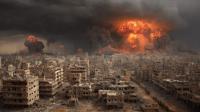
Russia in the Age of AI Power
Russia is a civilizational power (a state-civilization), not merely a nation-state or a peripheral economy. Its historical existence and future are determined not only by raw materials, territory, or even nuclear parity, but by its ability to preserve and develop a sovereign identity in an era when the primary struggle takes place in the domain of software, algorithms, artificial intelligence, and the digital control of reality.
Thiel’s Eschatological Error
Iran’s Example and the Will to Victory
Between Epstein Island and Iran, Where Does Europe Stand?
Alexander Dugin: It seems to me that in our volatile world, where everything is on the brink and hanging by a thread, we may face the most incredible twists and turns. Therefore, I do not believe any analysis that claims “this is long-term, and we know for sure” or “this is about to end, and we know for sure.”
The Soviet Arsenal Against the West
Iran's War for the World
Trump the Destroyer
Opening Speech by the Russian philosopher Alexander Dugin at Session 1: South and Pacific Asia
Online Conference — Multipolar Order in the Face of US-Israeli Aggression on Iran
The Eschatology of Acceleration: Baal, the Katechon, and the War for Time
Iran: The Last Stand against Baal
The Philosophical Front of AI
Vladimir Putin has signed a decree establishing a commission on the development of artificial intelligence (AI). The commission will operate under the President of Russia. Yet the issue of AI is not merely—or even primarily—a technical matter. It is a philosophical and conceptual problem. It calls into question rationality itself, the very human capacity for thought.
Defender of the Fatherland Day
The Munich Crossroads
The 5 Poles of the Trumped West
The Shadow War on Russia’s Command
The New Atlanticism of Marco Rubio
Epstein and the Unmasking of the Satanic Elite
I think that is entirely correct: this is exactly how everything should be understood. If one looks objectively at the effect produced by the publication of the Epstein files—even in such a redacted form, with black bars and an incomplete set (they say that only three to six million files have been published, and since they were carefully selected, these are surely not the harshest).
The Epsteino-Centric Model: A Sociopolitical Analysis of the Western Power Core
Pedophile Presidents and the Epstein Files
The publication of three million Epstein files is a foundational event of such magnitude that it provokes genuine bewilderment: why are domestic media outlets failing to give it the attention it deserves? This is a true event—if you will, an anticipated yet still shocking “black swan,” or what political analysis calls a “game changer,” a transformation of the conditions of the game.
The Cave and the Empire
The West in Its Terminal Phase
Multipolarity by Force
Is there a political philosophy in the Neo-Platonic tradition?
Friedrich Nietzsche, in his lectures on Greek philosophy, called Plato a radical revolutionary. Plato, in Nietzsche's interpretation, is the one who surpasses the classical Greek notion of the ideal citizen: Plato's philosopher becomes above religiosity, directly contemplating the idea of the Good, unlike the other two properties (war and artisans).