Welsh rep podcast 143 Alexsandr Dugin
Another Russian thinker belonging to the late Slavophiles was Nikolai Yakovlevich Danilevsky (1822-1885). Danilevsky came from a line of high-ranking aristocrats. His father was a general. He was not a professional philosopher, focusing primarily on natural science, in particular, botany. In his fundamental work Russia and Europe,17 Danilevsky approaches the fundamental position of the plurality of civilizations or, as he puts it, “cultural-historical types.”
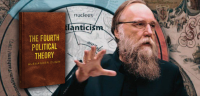
The Fourth Political Theory, upon recognising its preliminarily outlined structures, could become more systematic and detailed by examining some fundamentally important doctrines, schools, and figures for political philosophy. For instance, let us consider Hegel.
The starting point in their theories should be recognized precisely as the thought of Sophia - sophiology. You could even say that they considered Orthodoxy through sophiology, and not vice versa. This is fundamental; it allows you to clearly identify in their motivation the archaic principle itself, breaking through to the surface from under the tightening and painful fetters of focus B, imitating European rationalism.
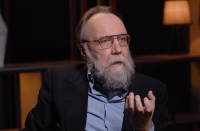
As we find ourselves approaching the end of 2023, how would you define the year 2023? Today we are happy to have Professor Aleksandr Dugin, he will reveal to us the Winner of 2023 in his mind.
Seriously speaking, liberal hegemony in the country is still very strong. Since 1991, virtually all major tenets disseminated in education, the humanities, and culture have been built strictly according to liberal templates.
Another key point of Solovyov’s reflections is the thesis of “all-unity.” It also represents an echo of the deep archaic intuition about the “cohesiveness”5 of all oppositions and differences.
In Hegel’s political philosophy, there is a fundamentally important transition concerning the establishment of the state (der Staat). In his notes on a course about Hegel, Heidegger focuses on the terminology of Staat — stato — status. The Latin root is stare — to stand, to establish, to set up. In the Russian language, the state (gosudarstvo) comes from the word государь (gosudar), meaning lord or master.
PRAV's Editor-in-Chief speaks out on the "message" of Daria Platonova Dugina's life and death and on her book *Eschatological Optimism*.
The themes related to the movements of the inner search for Being on the part of the Being-us, i.e. of the Dasein, which has realized in itself the consciousness of the reality of Being and seeks to attain it, to experience it in itself or to welcome it through its inner openness, to transfer to it, to identify with it, or otherwise, these are multiple themes that for the most part are not clearly identifiable and often, like the air one breathes but cannot see, fail to be crystallized in a critical reflection, as they lack the reality of being an experienced induction before becoming a reflexive deduction.
Constantin von Hoffmeister talks with Alexander Dugin about the current state of Eurasianism and multipolarity, Guillaume Faye’s concept of Eurosiberia, Western racism amidst claims of universalism, the immortality of the soul as the foundation of the Fourth Political Theory, and other topics.
Certainly, there are those who voluntarily and consciously went to war, already possessing an ideology. There are the convinced rightists (Orthodox, monarchists, imperialists). There are the leftists (Stalinists, anti-globalists). There are left-rightists — National Bolsheviks. By the way, Prigozhin articulated, in many respects, exactly the left-right discourse — justice and strength.
The appearance in the first quarter of the 19th century of Russian conservatives (the so-called “Russian party”: Shishkov, Rastopchin, Glinka, etc.) and Slavophiles especially can be represented in this diagram as an achievement of the “haughty” Eurocentric ellipse expanding its reach to the points of Focus A (Figure 2) and the first intelligible and conscious intuitions of the Russian intellectual and political elite regarding the fact that Russia is a distinctive and original culture and civilization, not just a “European country.”
The foundation of the Fourth Political Theory is Dasein, the essence of the Fourth Political Theory is the Vision of the Sacred, the profound substance of the Fourth Political Theory is the reality of the Soul.
On the eve of 2024, it is worth taking a look at the overall picture of the world and the main geopolitical trends. Overall, we are in a moment of transition from unipolarity to multipolarity. This year, multipolarity received additional structuring in BRICS-10 (Argentina, having just joined this organisation, was hastily removed from there by another globalist clown — Javier Milei).
Russian culture embarked on the path of the archeomodern from the end of the 17th century, but its first signs appeared even earlier - from the first half of this century.
The adoption of Orthodoxy by the Grand Duke of Kiev Vladimir was the starting point of Christian historicity, which covers almost the entire history of Russia - with the exception of the Soviet period and the era of liberal reforms. This historicity itself was a complex and multidimensional process, which it would be wrong to describe as a gradual and unidirectional penetration of Byzantine Orthodox culture into the popular environment, in parallel with the displacement of pre-Christian ('pagan') ideas. Rather, we are talking about different phases of the temporal synthesis between Byzantinism and East Slavic demetriac civilisation, phases determined by the different correlation of the main structures - Byzantine ideology at the elite level and the reception of Christianity by the people as such.
It is not up to us to choose the actual time and manner in which a Radical Subject, from a human aspiration of an existential order and consequent intellectual adherence to the values and truths preached by the Fourth Political Theory, can transform and transfigure itself into a concrete metaphysical and spiritual human reality that in its essence is res of a mystical-eschatological order.
On the threshold of the jubilee congress of the World Russian People’s Council in the Kremlin, which is dedicated to the Russian World, it is necessary to address the very concept of “Russian World” in a little more detail.
Alexander Dugin discusses the emerging multipolar world, highlighting the distinctive ideological and civilisational paths of various global regions in opposition to the Western liberal paradigm.
Nevertheless, from time to time we use the combination of words, “Russian philosophy,” and we list the names of “Russian philosophers”: Skovoroda, Solovyov, Fedorov, Leontiev, Bulgakov, Berdyaev, Trubetskoy, Frank, Florensky, Shestov, Kojève, Losev. Who are they, then, and what were they up to?
In the context of global challenges, Russia is finding its unique path and national idea. One of those who is indispensable in understanding Russia’s role and place in the modern world is Alexander Dugin — a political scientist, philosopher, and ideologist of Eurasianism.