

Philosophy of politics (1)
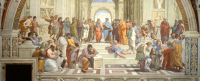
Although there is a philosophy that free from politics occupies itself with non-political questions, in fact, in one way or another, even such a free, non-political philosophy is connected, in one way or another, with politics, inasmuch as philosophy and politics have a common root. For this reason, if philosophy considers aesthetic questions, historical questions, cultural questions, and says nothing about politics, this nevertheless does not mean that it is a completely separate phenomenon. Any philosophy at all, even the most abstract, has a political dimension, in some cases explicitly. In the case of Solon, as in the case of the ancient Greek Pre-Socratics and Wise Men, and as in the case of Plato and Aristotle, this is an explicit dimension of philosophy. But there is also an implicit political dimension of philosophy, when philosophy says nothing about politics, but the very fact of the presence of a philosophical paradigm of one or another already carries in itself the possibility of a political dimension. In one case it is only explicit, open, and manifest; in the other, it is implicit, contained.